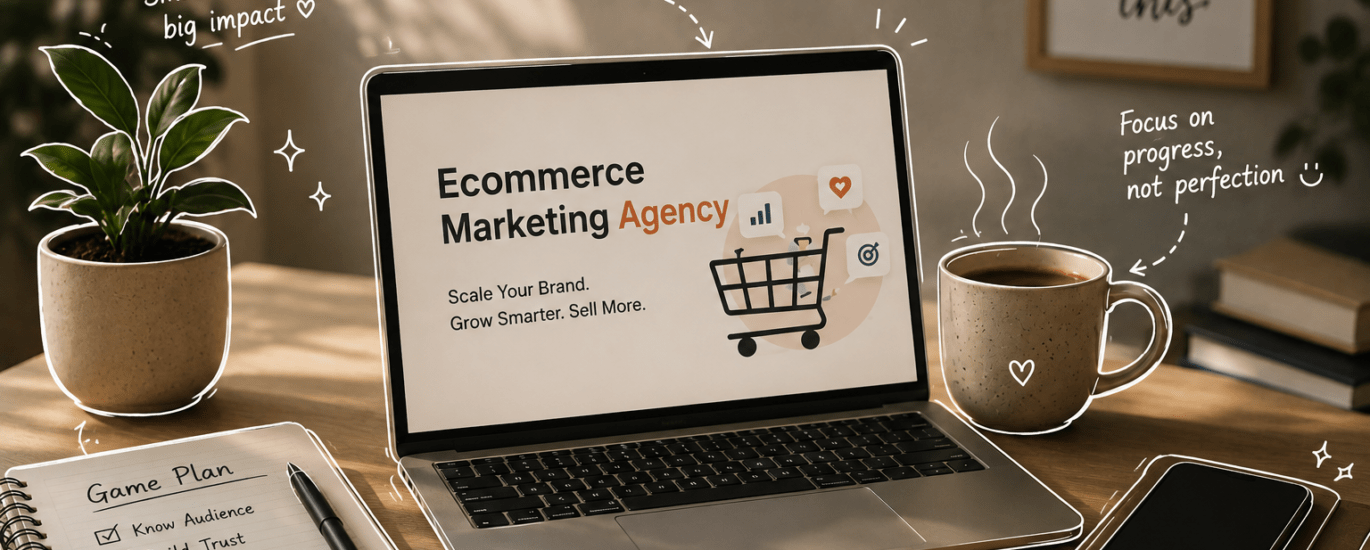
Running an online store is surely an exciting task, until you realize having a great product is just 50% of the journey. The remaining 50% of the journey is to actually find your store, trust it, and buy from it, again and again. That’s exactly what Ecommerce Marketing Agency is all about.
So, if you have been googling agencies at 1 AM and wondering which one is the best for you given your ad budget, you’re absolutely in the right place. This detailed blog covers what an ecommerce marketing agency actually does, the different types of ecommerce it can support, and how to choose a partner that will genuinely help increase your revenue in 2026, not just your ad spend.
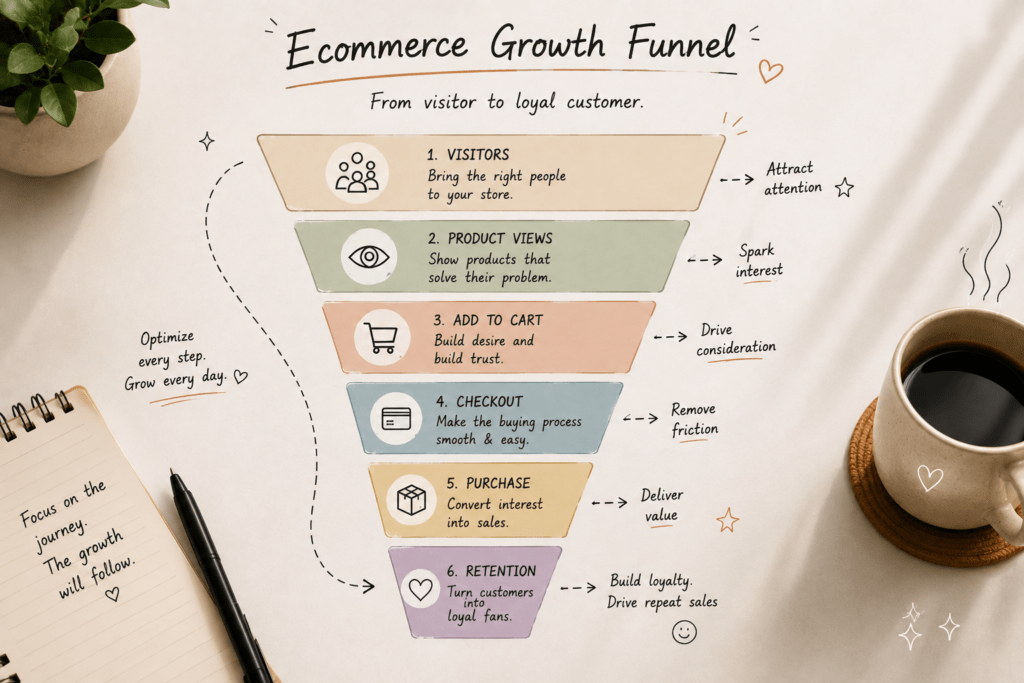
What is An Ecommerce Marketing Agency?
An ecommerce marketing agency is basically a team of specialists who help online brands attract traffic, convert visitors into paying customers, and keep those specific customers coming back again to your site. Instead of building an entire department in-house, you get instant access to strategists, media buyers, designers, copywriters, and analysts who understand online retail specifically, not just marketing in general.
That kind of distinction matters more than ever. Online shopping now accounts for roughly a fifth of all global retail sales, and the share keeps climbing every year, according to a report on the Shopify Website. This means that competition for attention is only getting more expensive. An agency that lives in this world-day-to-day understands checkout friction, product feed optimization, the seasonal sales cycle, and marketplace algorithms in a way generalists simply can’t.
A capable e-commerce ad agency typically handles:
- Paid advertising (Meta, Google, Tiktok, Amazon Ads)
- SEO and content marketing
- Email and SMS marketing automation
- Conversion rate optimization (CRO)
- Social media and influencer marketing
- Marketplace management (Amazon, Walmart, Etsy)
- Analytics, tracking, and performance reporting
What are the Types of Ecommerce?
Before picking any marketing partner, it will be helpful for you to know exactly where your brand fits, because strategy shifts a lot depending on the business model. Here are some types of ecommerce:
1) B2C (Business-to-Consumer)
The most common model, where brands sell straight to individual shoppers (fashion, skincare, gadgets).
2) B2B (Business-to-Business)
Companies selling products or services to other businesses, usually with bulk orders and longer sales cycles.
3) C2C (Consumer-to-Consumer)
Marketplaces like eBay or Facebook Marketplace, where individuals sell their products to other individuals directly.
4) D2C (Direct-to-Consumer)
Brands that skip retailers entirely and sell directly from their own website, a model that keeps growing in 2026.
5) C2B (Consumer-to-Businesses)
Individuals offering products or services to businesses, a much more common category among freelancers and creators.
6) B2G (Business-to-Government)
Businesses selling to government agencies, typically through formal contracts.
Why Does this Matter?
A strategy built for a fast-moving D2C skincare brand won’t translate to a B2B wholesale supplier. A good agency adapts its playbook based on which type of ecommerce you actually run, instead of forcing every client into one particular place or similar funnel.
Why Does Your Brand Need an Ecommerce Marketing Partner?
You can definitely try to do everything by yourself, even marketing, and plenty of founders even do. But ecommerce marketing has gotten much harder to pursue, especially alone. Ad platforms shift their algorithms constantly, privacy changes keep disrupting tracking, and shoppers expect a smooth and seamless experience across every channel they touch.
The numbers prove the evidence for this. On average, about 7 out of 10 online shoppers add something to their cart and leave without buying that product, according to the Baymard website. A stat that has been the same for quite a few years, largely because most of the stores never fix the small checkout and follow-up issues that are causing this issue. On the other hand, email marketing has made great improvements.
Email marketing continues to punch well above its weight, with the industry benchmarks putting the average return at $36 to $42 for every $1 spent, far higher than most paid ad channels. An experienced agency knows fully how to actually capture that kind of upside instead of leaving it on the table.
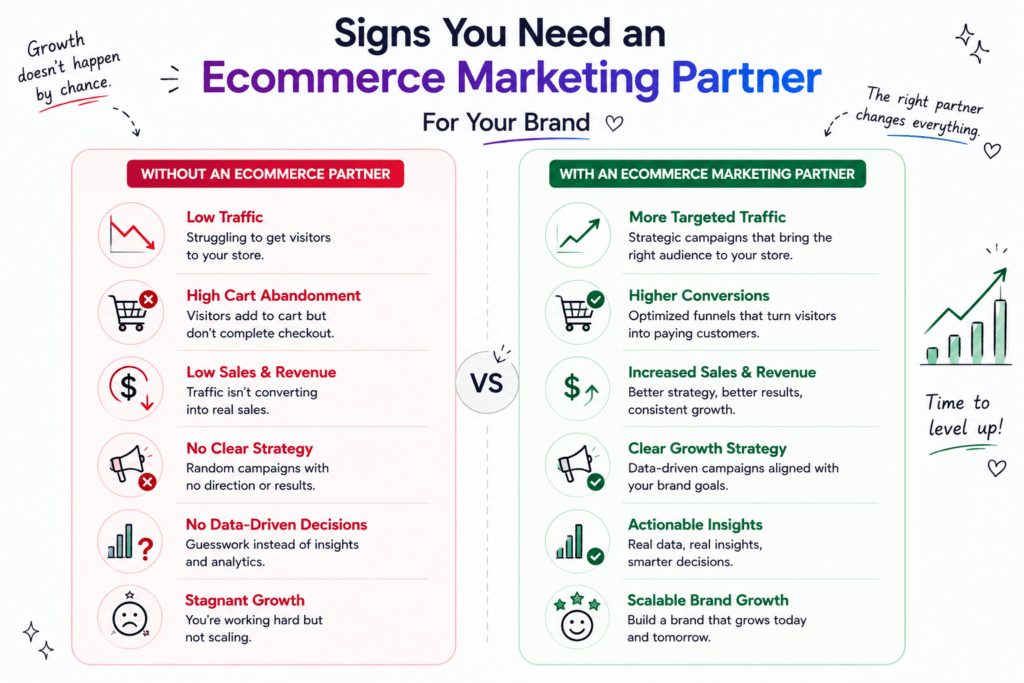
How to Find the Best Ecommerce Marketing Agency in 2026?
Not every agency is created in an equal manner. Some are excellent at paid ads but quite weak on strategy. Some convey a great brand story, but can’t even read a simple spreadsheet. So, here’s what you should actually look for in any agency before you deal with them.
| What to Check | Why it Matters | Red Flag to Watch Out For |
| Ecommerce-Specific Case Studies | Proves they understand retail metrics like AOV, ROAS, and LTV | Only generic “brand awareness” campaigns |
| Transparent Reporting | You should look for real numbers, not vanity metrics | Vague monthly PDFs with no raw data access |
| Multi-Channel Expertise | Ecommerce growth needs SEO, paid, and email working together | Agency offers only one service |
| Clear Communication | Regular calls and a dedicated account manager | Slow replies, no single point of contact |
| Realistic Promises | Growth takes strategy and consistency testing | “Guaranteed” overnight results |
| Contract Flexibility | You shouldn’t be locked into a bad fit | Long lock-in terms with heavy exit fees |
An Important Tip: Always ask for references from brands that are similar in size and category to yours. A team built for a $50M brand may overwhelm, or underprice, a business that’s just starting to scale.
Conclusion
Choosing the best ecommerce marketing service provider in India isn’t just about finding someone who “runs ads”. It’s actually about finding a partner who understands your specific type of ecommerce business, communicates clearly, and backs up their promises with real data. Take your time, ask the harder questions, and don’t settle for any generic, one-size-fits-all pitch.
So, if you’re also tired of searching and ready to work with a team that actually understands ecommerce growth, it’s great to connect with the best ecommerce marketing agency in India that solves your problems. Make your choice today and give your brand the growth and scalability it deserves.
Frequently Asked Questions (FAQ)
Q1. How much does an ecommerce marketing agency cost?
Pricing varies widely by scope, but most small to mid-sized brands spend somewhere between $2,500 and $10,000 per month for ongoing management, with larger full-service retainers running $15,000+ for brands managing multiple channels and higher ad spend.
Q2. How long does it take to see results?
Paid ads can show early signals within weeks, but sustainable growth, especially from SEO and retention channels like email, typically takes 3 to 6 months to compound meaningfully.
Q3. What’s the difference between an ecommerce agency and a general digital marketing agency?
A general agency may split focus across many industries. An ecommerce-focused agency lives inside retail-specific metrics daily: conversion rate, cart abandonment, repeat purchase rate, and builds strategy around them.
Q4. Can a small ecommerce brand benefit from hiring an agency?
Yes. Many agencies offer single-channel packages (like paid social only) specifically for smaller brands that aren’t ready for a full-service retainer yet.
Q5. Do I need separate agencies for SEO, ads, and email?
Not necessarily. Many modern ecommerce agencies manage multiple channels under one roof, which usually improves consistency and avoids strategy conflicts between teams.